
Finance Minister P Chidambaram on Tuesday said that the 0.25 per cent hike in repo rates by the Reserve Bank of India

'Investment creates capacity and reduces inflation. Income, employment, and savings rise.'

The report, however, said it remains watchful of the upside risks to inflation emanating from pass-through of minimum support prices (MSPs), adverse movement in crude oil prices, volatility in global financial markets, lagged impact of the rupee weakness on input prices, adverse implications from fiscal slippage and staggered impact of HRA increases by states and its second-round impact.
In its Third Quarter Review of Monetary Policy 2012-13, the Reserve Bank of India has reduced the policy repo rate under the liquidity adjustment facility (LAF) by 25 basis points from 8.0 per cent to 7.75 per cent with immediate effect.

IT and interest rate-sensitive bank, realty, and auto stocks ended with sharp gains.
The Reserve Bank of India on Friday decided to keep the benchmark interest rate unchanged at 4 per cent but maintained an accommodative stance as the economy is yet to recover from the impact of the second Covid wave.

Governor Urjit Patel and his deputies spoke to the media about the central bank's decision to raise the repo rate.

This week, bond yields are expected to soften while the rupee could strengthen.
The central bank deputy chief said on Monday that the monetary authorities were unlikely to lower the repo rate from the current five per cent for quite some time.\n\n\n\n

The liquidity in the banking system moved into surplus almost after three months as the Reserve Bank of India (RBI) absorbed over Rs 40,000 crore from the market on Monday, predominantly on the back of increased government spending. However, this situation may be short-lived given the higher demand for funds to pay taxes and year-end targets, treasury executives said. Meanwhile, two variable reverse repo rate (VRRR) auctions held on Tuesday received weak response.

To minimise risk, invest in a debt fund whose duration matches your investment timeframe.

As the policy rate has seen a steady increase since May 2022, the percentage of loans offered at interest rates below 8 per cent have declined sharply, dropping from 53 per cent in March 2022 to 18 per cent by June 2023, according to a report by the Reserve Bank of India (RBI). The share of bank loans with interest rates of 10 per cent or higher rose from 22 per cent to 34 per cent during this period, reflecting the impact of a 250 basis point (bps) hike in the policy repo rate by the RBI's Monetary Policy Committee. In response to the rise in repo rate, 32 domestic banks have made corresponding upward revisions to their repo-linked external benchmark-based lending rates (EBLRs), aligning them with the magnitude of the rate hike.

The repo rate, at which RBI lends to the banking system, will be at 7.5%

Mukherjee said uncertainty was still there on oil prices front due to unrest in West Asia and North Africa.

The expectations of a borrowing cut by the government faded among bond-market participants after the general election results because they feel the compulsions of running a coalition may put pressure on the exchequer, according to dealers. The recent trend of moderate depreciation in the rupee's nominal effective exchange rate (NEER) might not persist if there are significant changes to the structural reform agenda.

MMFs invest in fixed-income instruments maturing in less than one year, minimising interest-rate risk.
Majority of the experts expect a 25 basis point reduction.
British banking major RBS on Thursday said it expects the Reserve Bank to cut key rate by 25 basis points or 0.25 per cent in its monetary policy review next week, leaving the cash reserve ratio (CRR) unchanged.

The highlights of RBI's bi-monthly monetary policy announced by Governor Shaktikanta Das:

The main reason was that CPI inflation would likely remain below 4 per cent till July.

By taking the mutual fund route, investors can take exposure to gilts with small amounts. Over a decade or more, returns from these funds tend to be sound.

Among the Sensex constituents, 20 stocks ended the session in green with HDFC Bank, Titan, Tech Mahindra, and Asian Paints being the major gainers. TCS, Maruti, Kotak Mahindra Bank and Bajaj Finserve were the other gainers. In contrast, SBI, Bharti Airtel, JSW Steel, PowerGrid, ITC and Reliance closed the trading with losses.
Reserve Bank of India governor, Bimal Jalan, said on Monday there was no proposal to cut the repo rate as of now and added the bank's bias towards soft rates would continue.

The Reserve Bank is likely to cut the repo rate by 25 basis points (bps) after the Budget.

The Reserve Bank on Friday said India is poised to become the growth engine of the world as it retained the GDP projection for the current fiscal at 6.5 per cent. Unveiling the bi-monthly monetary policy review, Reserve Bank of India (RBI) Governor Shaktikanta Das said the domestic economy exhibits resilience on the back of strong demand.

The monetary authority said it was worried on three fronts with regard to inflation as well as the economy.
Reserve Bank of India has kept options open for a possible repo rate cut but said there was no "great urgency" for slashing it from the present level of 5.0 per cent.
'The rate cut could have been higher in the current economic conditions which would have had a stronger impact on business sentiment and spurred investment in a big way.'

LIC Housing Finance (LICHF) delivered a healthy FY24 with improvements in net interest margin (NIM) and credit costs and an improved return on assets of 1.7 per cent compared to an average of 1.3 per cent between FY14-FY23. Loan growth was low due to technology upgrades to the platform in H1FY24, though momentum improved in H2FY24. In Q4FY24, the net interest income (NII) came in at Rs 2,250 crore.
Banks and bond dealers expect RBI to slash its bank rate by 0.50 per cent and reduce repo rate by 0.25-0.50 per cent in the forthcoming busy season credit policy, going by the excess liquidity and lower yield on government papers.

Fundraising through qualified institutional placement (QIP) has revived this year, led by commercial banks, after a lacklustre 2022. According to data compiled by Prime Database, Indian companies have raised Rs 53,070 crore in 2023 so far, of which seven banks - Union Bank of India, Indian Bank, Bank of India, Federal Bank, IDFC First Bank, Bank of Maharashtra, and J&K Bank - account for Rs 21,290 crore, or about 40 per cent. If other financial institutions are included, the figure surges to Rs 26,690 crore.

The banking system's liquidity slipped into deficit for the first time in the current financial year (2023-24) due to the imposition of the Incremental Cash Reserve Ratio (I-CRR) for banks and outflows from goods and services tax (GST) payments, according to dealers. Reserve Bank of India (RBI) data shows it injected Rs 23,644 crore on August 21. The last time liquidity was in deficit was on March 27, when the RBI injected Rs 45,575 crore.
The Reserve Bank of India has no plans to cut the short-term repo rate for some time, a senior central bank official said on Thursday.

The apex bank in its monetary policy for 2010-11 hiked the repo and the reverse repo to 5.25 per cent and 3.75 per cent, respectively, and the CRR to 6 per cent.
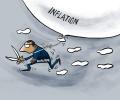
Most members of the Reserve Bank of India's monetary policy committee (MPC) decided to stick to the course on bringing retail inflation to the target of 4 per cent while voting for maintaining status quo in the April review, except external member Jayanth Varma who voted for a 25 bps cut in the repo rate. "I believe that the extant monetary policy setting is well positioned," RBI governor Shaktikanta Das said in the minutes of the policy review, which came out on Friday. "Monetary policy transmission is continuing and inflation expectations of households are also getting further anchored.

The Securities and Exchange Board of India (Sebi) might relax the disclosure norms around rumour verification to help smooth implementation and ease compliance amid pushback from India Inc, said people in the know. The rule has been notified following amendments to the Listing Obligations and Disclosure Requirements (LODR) by Sebi. However, its implementation has been deferred until February.
CLSA says government actions to facilitate investment more important for revival than a token monetary easing.
The liquidity in the banking system could ease in the coming week due to an increase in government spending - a development that would be the key for the Reserve Bank of India (RBI) to decide whether to extend the incremental cash reserve ratio (I-CRR) mandate for banks. There are signs of improvement in the liquidity scenario as banks parked Rs 25, 833 crore with the RBI on Thursday. Market participants expect liquidity to gradually improve by the end of the month or during the first week of September, aided by government spending.

The year 2022 saw the Reserve Bank of India (RBI) start acting on the policy repo rate after a gap of two years. The six-member monetary policy committee of the RBI reduced interest rate sharply - by 115 bps - when Covid-19 struck in 2020. In March 2020, days after the nationwide lockdown was announced, MPC in an unscheduled meeting reduced the repo rate by 75 bps, followed by another 40 bps in May. Status quo was maintained for the next two years since the May repo rate hike.

Interest rate sensitive stocks gain ground post decision
